
The live buyer-side issue is no longer just that the Trade Remedies Authority opened an anti-dumping investigation into rutile titanium dioxide from China. The operational point is sharper: a 26 March 2026 public notice now requires HMRC to register imports of the goods from 27 March 2026, using additional code 8A60 for in-scope goods.
That does not mean an anti-dumping duty has already been imposed. It means the import file has become more sensitive. The notice is not a blanket warning on every China-made coated, painted or plastic component. The first question is narrower: are the goods being imported themselves within the rutile titanium dioxide goods description and the listed commodity-code position?
If a UK buyer is sourcing China-origin pigment, coated material, plastics, paper products or non-standard components where rutile titanium dioxide is part of the material chain, the next RFQ should not treat this as a background policy story. It should become a short evidence check with the supplier and customs broker.
Reader walks away knowing
- What the record now shows on the import declaration
- Why this matters before the next China RFQ is accepted
- The declaration check is narrower than the headline
- Supplier-shortlist scenario: the cheaper supplier is not cheaper until the material record is clear
What the record now shows on the import declaration
The TRA announced on 3 March 2026 that it had initiated an anti-dumping investigation into imports of rutile titanium dioxide from China. The published case says the goods under investigation are rutile titanium oxides in pigments and preparations based on rutile titanium dioxide, with at least 80% titanium dioxide by dry weight, classified under the stated CAS numbers.
The AD0086 public case file should be checked before relying on any commodity-code position, as the case file continues to be updated. On 26 May 2026, it listed affected commodity codes including 2823 0000 10, 2823 0000 30, 2823 0000 80, 2823 0000 83, 3206 1100 10, 3206 1100 30, 3206 1100 80 and 3206 1100 85.
The later registration notice is the practical control point. It says HMRC will register the goods from 27 March 2026 and that, if a definitive remedy is implemented for registered goods, duties may be payable from a date up to 90 days before any provisional remedy is implemented. It also says importers must enter additional code 8A60 when importing the goods concerned. For excluded forms such as anatase or brookite, the notice says importers must enter additional code 8A61 to show that the goods are not subject to registration.
For a buyer, that means the useful question is not "will there be a duty?" The useful question is "would our import record show that this shipment is in scope if the case later creates a duty exposure?"
Why this matters before the next China RFQ is accepted
Rutile titanium dioxide is not always bought as a standalone chemical by the same person who approves the finished China supplier quote. It can sit inside pigment systems, coatings, plastics, masterbatch, paper coatings or painted components. That creates a gap between the technical material record and the commercial purchase order.
The buyer-side risk is not that every China-made coated or plastic part suddenly carries a new duty. The registration notice is narrower than that. It applies to the defined rutile titanium dioxide goods and excludes other forms such as anatase or brookite. The risk is that the buyer, supplier and broker each assume someone else has checked whether the material, commodity code and additional code are aligned.
That gap matters in three places:
- The supplier quote may not show whether rutile titanium dioxide is a material input, a finished imported good, or irrelevant to the shipment.
- The broker may only see the declaration data supplied to them, not the buyer's commercial concern about later duty exposure.
- The buyer's finance team may see a statutory cost change later without a clear file note explaining when the risk was first visible.
This is why the check belongs before the next commitment, not after the TRA case reaches a later determination.
The declaration check is narrower than the headline
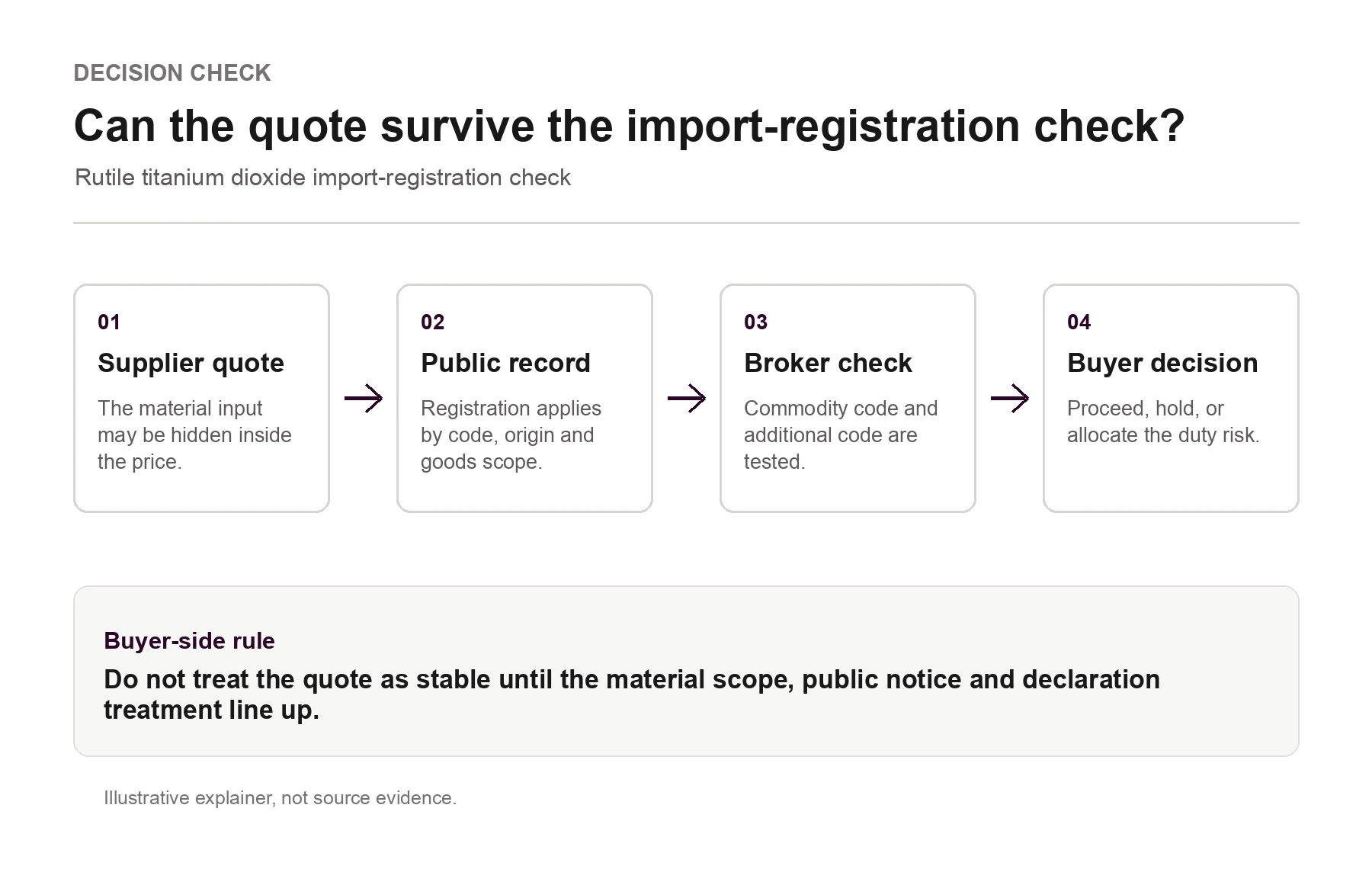
The registration notice gives the buyer a concrete file test:
- Does the product being imported match the goods description for rutile titanium dioxide?
- Is the commodity code one of the affected codes listed in the notice or AD0086 case file?
- If the goods are in scope, is additional code 8A60 being used?
- If the goods are excluded forms such as anatase or brookite, has the exclusion position been documented, including additional code 8A61 where the notice requires it?
This should be handled as an evidence question, not a negotiation tactic. A supplier saying "not affected" is not enough by itself. The useful answer is a short material and declaration trail: product specification, commodity code, form of titanium dioxide, origin, and the broker's view on whether the registration notice applies.
Supplier-shortlist scenario: the cheaper supplier is not cheaper until the material record is clear
Consider a UK buyer comparing two Chinese suppliers for a coated industrial component. Supplier A is cheaper and says the coating formulation is "standard white pigment." Supplier B is more expensive but provides a material statement showing the pigment system and confirms whether rutile titanium dioxide is present.
Before the buyer treats Supplier A as cheaper, the buyer should ask three questions:
- Is any rutile titanium dioxide being imported as the goods themselves, or is it only an upstream input into a finished component?
- If the import is in scope, which commodity code and additional code will the broker use?
- If a definitive remedy later creates duty exposure, who owns that statutory cost under the quote or contract?
The answer may still be that Supplier A is acceptable. But the decision is different once the buyer has separated price, material scope and declaration treatment.
The cost line should be modelled as a variable, not invented
The current public record does not give a final anti-dumping duty rate for this case. A buyer should not insert an invented rate into the landed-cost model.
The defensible model is:
Current landed-cost line= purchase price + freight + insurance + ordinary duty treatment + import VAT treatmentRisk line if a future remedy applies= current landed-cost line + applicable anti-dumping duty, if imposed and if the import is in scopeThe rate is deliberately blank until a public notice or tariff record gives one. GOV.UK guidance says importers should check trade remedies notices and the online Trade Tariff for commodity codes, duty and VAT rates. It also notes that anti-dumping and countervailing duties are based on non-preferential origin, which is why the supplier evidence and declaration treatment have to be checked together.
Control points before the next shipment or contract renewal
Before signing the next RFQ, framework agreement or shipment instruction, the buyer should create a short file note covering:
- Material scope: whether rutile titanium dioxide is present and whether the imported goods match the notice definition.
- Declaration scope: commodity code, origin, additional code and any exclusion basis.
- Supplier statement: whether the quoted price assumes current duty treatment only, or includes a clause for statutory cost changes.
- Broker confirmation: whether the registration notice changes the declaration data needed for the shipment.
- Finance trigger: who reviews the cost model if the TRA publishes a provisional or definitive measure.
This is a small control, but it prevents a later argument about who should have seen the trade-remedy signal first.
Plinth&Co's role is to keep the buyer's decision traceable: supplier-side checks in China confirm the material record, quote terms and shipment timing before the buyer commits.
Sources
Trade Remedies Authority, TRA opens investigation into Chinese imports of titanium dioxide: www.gov.uk/government/news/tra-opens-investigation-into-chinese-imports-of-titanium-dioxide, published 3 March 2026.
Trade Remedies Service, AD0086 - Rutile Titanium Dioxide from China: www.trade-remedies.service.gov.uk/public/case/AD0086, public case file.
Department for Business and Trade, Trade remedies notice 2026/14: registration of imports of rutile titanium dioxide originating from China: www.gov.uk/government/publications/trade-remedies-notice-registration-of-imports-of-rutile-titanium-dioxide-originating-from-china/trade-remedies-notice-202614-registration-of-imports-of-rutile-titanium-dioxide-originating-from-china, published 26 March 2026.
HMRC / UK Integrated Online Tariff, Registration of imports of Rutile Titanium Dioxide from China - 26 March 2026: trade-tariff.service.gov.uk/news/stories/registration-of-imports-of-rutile-titanium-dioxide-from-china---26-march-2026, tariff stop press.
Control points before commitment
- Does the product being imported match the goods description for rutile titanium dioxide?
- Is the commodity code one of the affected codes listed in the notice or AD0086 case file?
- If the goods are in scope, is additional code 8A60 being used?
- If the goods are excluded forms such as anatase or brookite, has the exclusion position been documented, including additional code 8A61 where the notice requires it?
Buyer-side control
Treat this briefing as a decision check before the next RFQ, deposit, shipment release or customs instruction. Confirm the live source record before using it as commercial advice. This is a buyer-side planning note, not legal, tax, customs or carbon-accounting advice; confirm final treatment with appointed providers or qualified specialists before acting. This is not legal advice, not tax advice, not customs advice and not carbon-accounting advice. Plinth&Co is not a factory. Plinth&Co is not a customs broker. Plinth&Co is not a tax adviser. Plinth&Co is not a law firm. Plinth&Co is not a carbon-accounting adviser.
Request a sourcing review