

HMRC and HM Treasury have updated the reference documents for tariff suspensions under The Customs Tariff (Suspension of Import Duty Rates) (EU Exit) Regulations 2020. The current GOV.UK page lists version 3.5 of the Suspensions of Import Duty Rates document, dated 12 May 2026, with entry into force on 21 June 2026.
The point for a UK buyer is narrow but important: a tariff suspension is not a supplier discount. It is a customs treatment that has to match the goods, the commodity code, the date and the evidence in the import file.
Reader walks away knowing
- What changed
- Why this matters for China RFQs
- The practical test
- A practical scenario
What changed
The GOV.UK publication says the reference document details the goods to which a tariff suspension applies, the tariff that applies to those goods, and the expiry date of the suspension. It also shows an earlier version, dated 3 March 2026 with entry into force on 1 April 2026, and the updated version dated 12 May 2026 with entry into force on 21 June 2026.
That means the working file for a live China RFQ should not rely on a copied duty assumption from an old quote. The buyer needs to check whether the quoted item still sits inside the relevant suspension description, whether the commodity code is still the same, and whether the expected import date falls inside the valid period.
Why this matters for China RFQs
Many supplier quotes arrive as a clean unit price plus an Incoterm. The landed-cost risk sits behind that clean number. If a supplier, broker or internal spreadsheet assumes a suspended duty rate, the buyer should treat that line as conditional until the commodity-code evidence is checked.
This is not only a customs-team issue. It can change which supplier looks cheapest, whether the buyer can approve a deposit, how much import VAT cash flow needs to be planned, and whether a DDP quote is hiding an assumption the buyer cannot verify.
For non-standard industrial parts, the danger is usually not that the buyer ignores a headline rate. The danger is that the part description, material, function or end use in the RFQ is too loose to support the commodity-code decision later.
The practical test
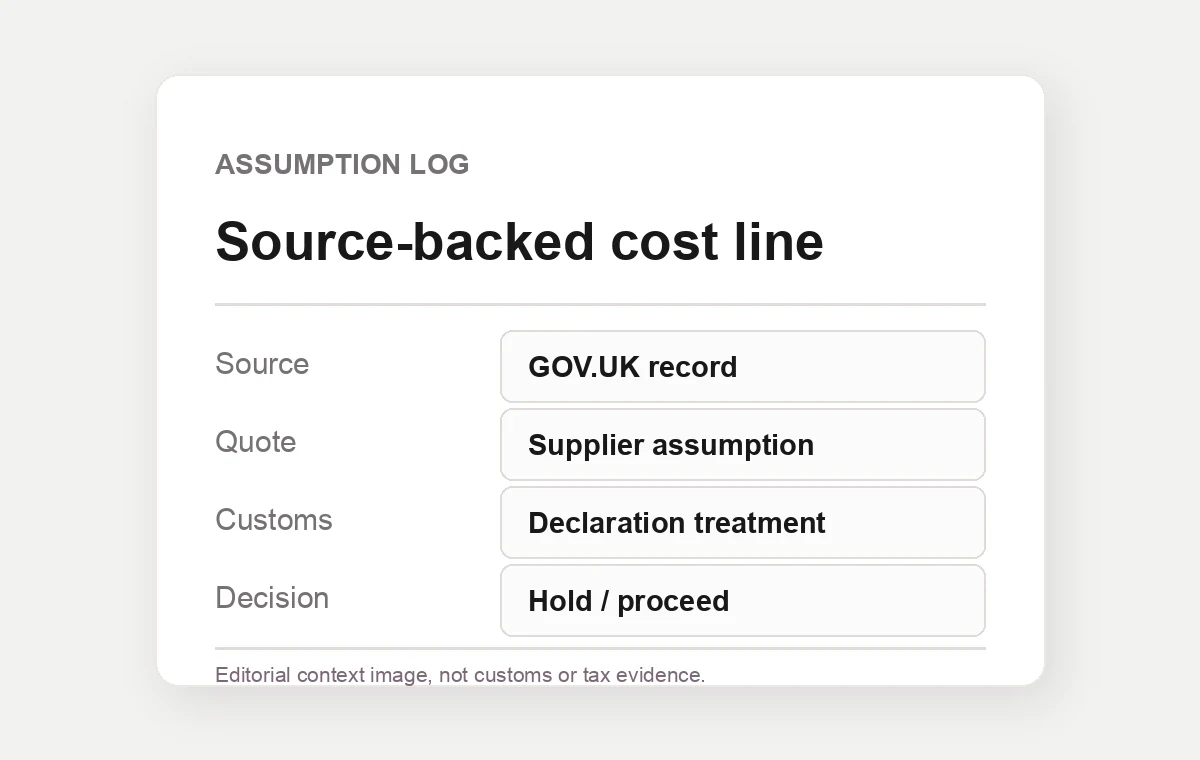
Before treating the suspension as usable, run four checks.
- Goods match: does the part actually match the goods described in the suspension reference document, not just a similar commercial description?
- Code match: does the commodity code used in the quote match the code the broker expects to declare?
- Date match: will the expected import fall inside the suspension period shown in the current reference document?
- Evidence match: do the drawing, material specification, supplier invoice and packing details support the same answer?
If one of those checks is unresolved, the lower duty line should stay as an assumption, not a confirmed saving.
A practical scenario
A UK buyer receives two quotes from Chinese suppliers for a fabricated metal component. Supplier A looks cheaper because the spreadsheet uses a suspended duty rate. Supplier B looks more expensive because the landed-cost model uses the ordinary rate until the broker confirms the commodity code.
The wrong decision is to choose Supplier A because the spreadsheet shows the lower total. The controlled decision is to ask for the missing RFQ evidence: drawing revision, material grade, intended use, Incoterm, shipment timing and the code basis used by whoever prepared the landed-cost line.
If the suspension applies, the saving can be recognised. If it does not apply, the buyer avoids approving a supplier on a false landed-cost comparison.
How to write it into the RFQ
Use short, explicit language in the supplier pack:
Suspension checkDuty assumption = commodity code + goods description + valid suspension period + broker confirmationDecision delta = confirmed landed cost - quoted landed costDo not ask the supplier to "confirm the UK duty rate" as if that settles the issue. Ask for the facts the broker needs to classify the goods: material, process, function, dimensions, finish, packaging, invoice description and any technical drawing or datasheet.
What to do before money moves
Pull the open RFQs, POs and shipments that use a suspended-duty assumption. Mark each one as confirmed, broker-check pending, or buyer assumption. Then update the landed-cost model with the source date and the person who confirmed the treatment.
For Plinth&Co, this is exactly where the UK-China bridge matters. The UK buyer keeps the decision accountable. The China-side execution work makes sure the supplier quote, product evidence and import file are not telling three different stories.
Sources
HMRC and HM Treasury, Reference Documents for The Customs Tariff (Suspension of Import Duty Rates) (EU Exit) Regulations 2020: www.gov.uk/government/publications/reference-documents-for-the-customs-tariff-suspension-of-import-duty-rates-eu-exit-regulations-2020 (live replay: HTTP 200; accessed 2026-05-24).
GOV.UK, Trade Tariff: look up commodity codes, duty and VAT rates: www.trade-tariff.service.gov.uk/find_commodity (used as the buyer-side commodity-code check point; accessed 2026-05-24).
HMRC, How to value your imports for customs duty and trade statistics: www.gov.uk/guidance/how-to-value-your-imports-for-customs-duty-and-trade-statistics (used for the landed-cost valuation control point; accessed 2026-05-24).
Control points before commitment
- What changed
- Why this matters for China RFQs
- The practical test
- A practical scenario
Buyer-side control
Treat this briefing as a decision check before the next RFQ, deposit, shipment release or customs instruction. Confirm the live source record before using it as commercial advice. This is a buyer-side planning note, not legal, tax, customs or carbon-accounting advice; confirm final treatment with appointed providers or qualified specialists before acting. This is not legal advice, not tax advice, not customs advice and not carbon-accounting advice. Plinth&Co is not a factory. Plinth&Co is not a customs broker. Plinth&Co is not a tax adviser. Plinth&Co is not a law firm. Plinth&Co is not a carbon-accounting adviser.
Request a sourcing review